
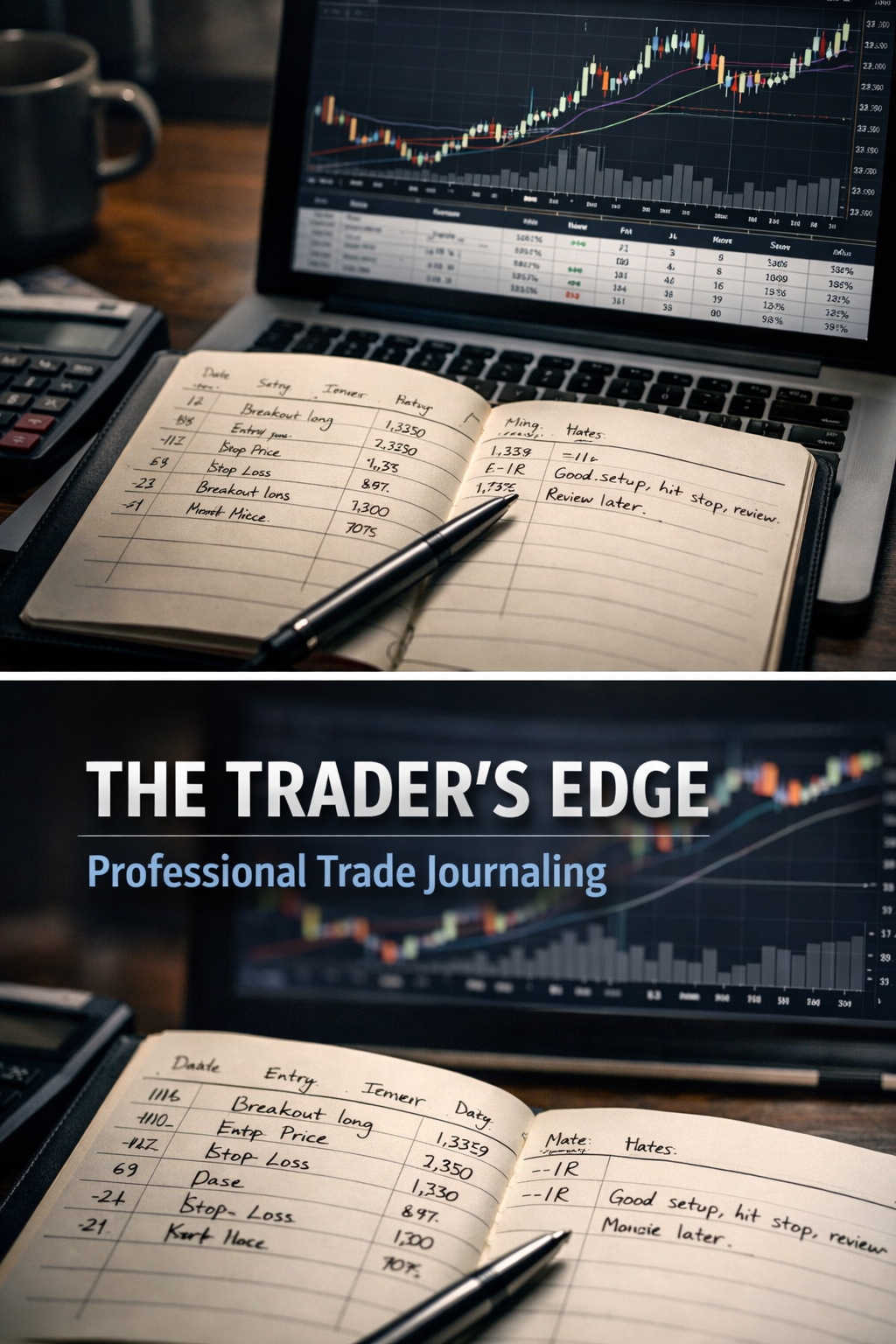
The Trader’s Edge: How Professional Trade Journaling Drives Consistent Performance
How structure, measurement, and review separate consistent traders from emotional decision-makers

Most traders believe their edge comes from finding better setups. Professionals know their edge comes from measuring themselves.
A trade journal is not a place to vent emotions or store screenshots. When built correctly, it becomes a performance system — exposing what works, what doesn’t, and why.
If you can’t measure your decision-making, you can’t improve it — and consistency stays out of reach.
Why most trade journals fail
Traders often record too little (just entry/exit) or track the wrong thing (P&L without context). A professional journal is about decision quality, not memory.
What a journal should do
A great journal turns trades into data, and data into improvements — so you can trade less emotionally, manage risk with clarity, and build confidence based on evidence.
- Recording only entry/exit prices
- Obsessing over dollars instead of risk-adjusted outcomes
- Writing emotional notes with no structure
- Reviewing randomly instead of using a repeatable process
What a Professional Trade Journal Tracks
At minimum, each trade should capture these five categories. This keeps the journal focused on the only thing you can control: your decisions.
1) Market Context
Define the environment before execution. Track bias, volatility condition, time of day, and higher-timeframe alignment.
2) Trade Thesis
Write the reason in one sentence. If you can’t explain the trade clearly, you probably didn’t see it clearly.
3) Risk Definition
Record planned stop distance, planned risk (in R), and position sizing logic. This separates controlled losses from mistakes.
4) Execution Quality
Track entry timing, exit logic, hesitation, and rule adherence. Most performance gains come from execution refinement.
5) Outcome Metrics
Track R-multiple, expectancy (over a series), win rate by context type, and drawdown/recovery behavior — not just dollars.
Reality Check
P&L tells you what happened. Your journal explains why it happened — and what to adjust.
Simple Journal Template (Copy This)
Keep it lightweight and consistent. You can track these fields in a spreadsheet, Notion, or a physical notebook.
| Category | What to Record |
|---|---|
| Context | Bias (Long/Short/Neutral), volatility condition, session/time-of-day, HTF alignment/conflict |
| Thesis | One-sentence reason (e.g., “Aligned participation + expansion; continuation setup”) |
| Risk | Stop distance, planned R, size logic (fixed vs volatility-adjusted), max loss rule followed (Y/N) |
| Execution | Entry timing (early/optimal/late), exit type (rule-based/emotional/target), hesitation (Y/N) |
| Outcome | R-multiple, notes on what you’d repeat/avoid, screenshot link (optional, only if useful) |
The Power of R-Multiples
One of the most important upgrades you can make is shifting from dollar-based thinking to R-based thinking.
- +1R= you made what you risked
- -1R= a controlled, acceptable loss
- +3R= one trade paid for three losers
This allows you to compare trades objectively, remove emotional attachment to dollar outcomes, and evaluate performance across instruments. Professionals don’t ask, “Did I make money today?” They ask:
“Did I execute my edge correctly — and what did the data say?”
How to Review Your Journal Like a Professional
Logging trades is worthless without structured review. Your edge emerges from the review cycle — not from writing notes.
Weekly Review
Focus on behavior: Did you trade the right environments? Respect risk rules? Repeat mistakes or isolate them?
Monthly Review
Focus on stats: expectancy by context, best/worst time-of-day performance, volatility conditions that helped or hurt.
Quarterly Review
Focus on evolution: what deserves more capital, what needs tighter rules, and what should be paused entirely.
Key Principle
Improve without overtrading. Pros study more when results degrade — they don’t “revenge trade” for certainty.
Your Journal Is Your Real Edge
Indicators change. Strategies evolve. Markets shift. Your ability to evaluate yourself objectively is permanent.
If you’re serious about trading as a skill — not a gamble — treat your journal like you treat your capital: with structure, consistency, and respect.
Ready to stop guessing and build a professional process?
The fastest way to improve is to combine structure with accountability. Book a free consultation to map your trading plan, or review our courses to enroll in a professional, rules-based curriculum.
Educational content only. Trading involves risk. Past performance does not guarantee future results.